
 EN
EN English
 Español
 عربى
عربى русский
A liquid receiver is an indispensable component in refrigeration systems and industrial equipment, primarily used to collect, store, and transport refrigerant or other liquid media. In refrigeration systems, a liquid receiver ensures stable refrigerant circulation and prevents gas-liquid mixing from affecting equipment efficiency. For vertically installed vertical liquid receivers, they not only provide safe liquid storage but can also withstand operating pressures up to 2.0 MPa, making them an ideal choice for refrigeration components.
Content
Applications of Vertical Liquid Receivers in Refrigeration Systems
Vertical liquid receivers are mainly used in central air conditioning, chillers, and industrial refrigeration equipment to ensure a smooth flow of liquid refrigerant. For example, in large chillers, the refrigerant circulates between the evaporator and condenser; a vertical liquid receiver can collect excess liquid, preventing refrigerant gas-liquid mixing that could overload the compressor. Data shows that proper use of liquid receivers can improve system efficiency by 5% to 10% while extending compressor lifespan.
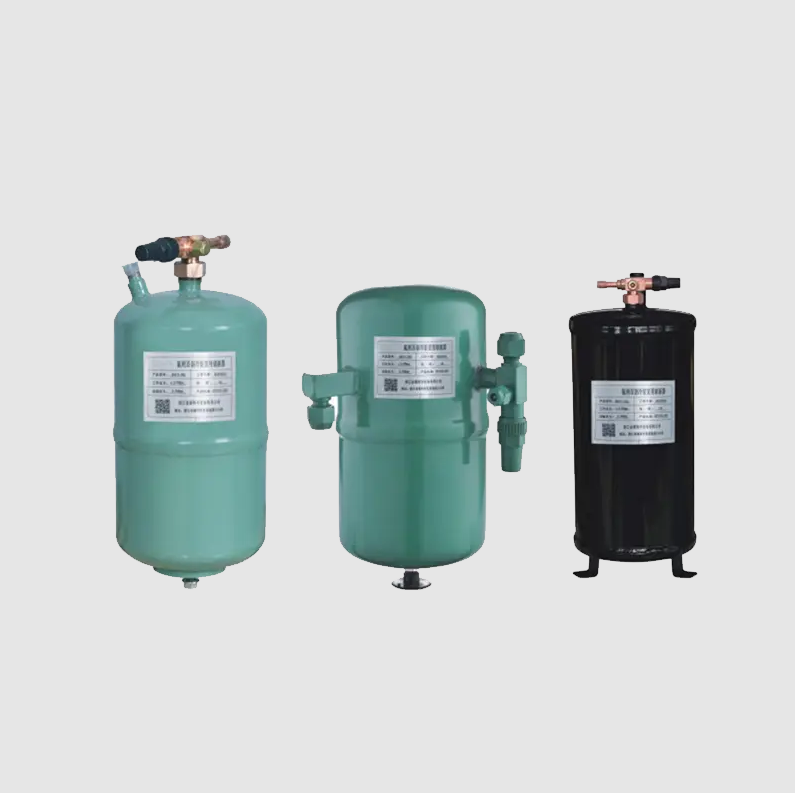
Advantages of Vertical Design and 360-Degree Rotary Valve
Compared to traditional horizontal liquid receivers, vertical liquid receivers require vertical installation, enabling efficient liquid storage within limited space. More importantly, this product is equipped with a high-quality rotary valve, allowing for 360-degree rotating installation. This enables more flexible liquid inlet and outlet placement, facilitating connection to refrigeration system piping. For example, in space-constrained cooling equipment, adjusting the inlet and outlet direction via the rotary valve reduces the number of pipe bends, thereby lowering pressure drop and energy consumption.
High Operating Pressure Ensures Safety and Stability
The vertical liquid receiver is designed to withstand the high-pressure environment of refrigeration systems, ensuring safe liquid storage and transportation. Compared to typical low-pressure liquid receivers, the high-pressure design not only improves system reliability but also ensures stable operation even under extreme conditions. For example, during peak refrigeration loads, the liquid receiver effectively buffers pressure fluctuations, preventing system overpressure that could lead to leaks or malfunctions.
Practical Recommendations for Choosing a Vertical Liquid Receiver
Installation Method: Ensure vertical installation to guarantee uniform liquid storage and discharge.
Valve Configuration: The 360-degree rotary valve design allows for flexible direction adjustment based on piping layout, simplifying installation.
Material and Pressure Resistance: High-pressure and corrosion-resistant materials are selected to ensure long-term safe use under a working pressure of 2.0 MPa.
By scientifically selecting and properly installing vertical liquid receivers, the efficiency of the refrigeration system can be significantly improved, energy consumption reduced, and the long-term stable operation of the equipment guaranteed.
The liquid receiver plays the role of the "liquid management center" in the refrigeration system. With its vertical installation design, high-quality rotary valve, and high working pressure of 2.0 MPa, the vertical liquid receiver not only ensures the safety of liquid storage but also optimizes piping layout and improves system efficiency.
 +86-0574-88198229
 +86-17757487298
 Zhejiang Province, Ningbo City, Yinzhou District